Wednesday, May 3, 2017

TURING MACHINE AND CPU


So about a week ago i watched 2 youtube videos explaining how a cpu works (in this article and the video aswell is going to talk about the v.neumann architecture) and a turing machine so our teacher told us to do a mind map explaining both of these topics. The mind map will be in this post so look forward to that.
Another thing this post is about is things the turing machine and the v.neumann cpu have in common if you are interested i am going to link the youtube videos so look at the bottom of the post to see them because i think to fully understand this post to watch both videos.


One of the things the two have in common and in my opinion the most important is that they both work with strings of ones and zeros so they do the same  thing on a very basic level another big thing is that at least the v.neumann structure only can view and transform one string at at time.


LINKS OF THE VIDEOS:
https://www.youtube.com/watch?v=cNN_tTXABUA
https://www.youtube.com/watch?v=dNRDvLACg5Q

Turing machines structures in a V. Neumann architecture


Hello, nice to see you again in this blog… In this post I will explain you which is the difference between Turing machine and V. Neumann architecture and try to find Turing machines structures in the V. Neumann architecture. I saw three videos, one is a explanation about how a Turing machine works and the second one is about the CPU and the last one is "How Turing machines work". I will summarize it  and try to explain it for you in the easiest way. For that purpose I will make a mindmap with Mindomo (look my post about C&D thinking and mind mapping to learn about Mindomo) to make it easier to understand. Furthermore I will add all videos at the end of the post. Let's begin.


Make your own mind maps with Mindomo.


Now we are going to look at some components of the V. Neumann architecture. You will recognize that some are Turing machines, for example the ALU or the Control Unit.
Summarizing, the ALU has an input, then he reads, follow instructions and write the output, this is what characterizes a Turing machine.

Videos:


I hope this information is useful fpr you,
if you have any doubt don´t forget to ask in a comment.

V-Neumann architecture and Turing Machines


The other day, I saw two videos. One was about How a CPU works and the other one was about How Turing machines work . In general, I liked the videos, although they were difficult to understand in some parts. But on the other side, they were both very informative and interesting. I made a mindmap, explaining the most important concepts of the V-Neumann architecture and turing machines. I used a programm called Mindomo, that helps you to elaborate virtual or digital mindmaps. Besides, I will also answer this question: Can you find a couple of turing-machine-like structures in a V-Neumann (CPU) architecture? Let's start.


Now, in answer to this question: Can you find a couple of turing-machine-like structures in a V-Neumann (CPU) architecture? 
Both, the Turing machine and the V-Neumann architecture recieve and send data using outputs and inputs. The V-Neumann arch. uses the idea of the turing machine to sole problems.  The turing machine uses inputs and outputs.


V Neumann architecture and Turing

Hello guys! How are you doing?
Today I am going to introduce you to a very interesting topic. Which is the,

 and the.
                          Who was the inventor from the Turing machine? 

 The famous mathematician, Alan Mathison Turing was born on 23 June 1912, in London.  In his seminal 1936 paper, he proved that there cannot exist any universal algorithmic method of determining truth in mathematics, and that mathematics will always contain undecidable propositions. That paper also introduced the "Turing machine". His papers on the subject are widely acknowledged as the foundation of research in artificial intelligence.
This is Alan Turing. 


Who was the inventor of the V Neumann architecture?

John von Neumann  (December 28, 1903 – February 8, 1957) was a Hungarian-American mathematician, physicist, inventor, computer scientist, and polymath. He made major contributions to a number of fields, including mathematics, economics, physics and computing.  
All modern computers are "Von Neumann machines" in that they have a single central combined program and data store: "memory." John Von Neumann was the one who suggested that computers do not need separate storage for data and instructions, and thereby changed Computer Architecture from that point on.
                                                      John Von Neumann.


So that you get to know a little bit more what this whole thing is about, I cretaed a MindMap (I already made a post about MindMaps and the best Apps I recommend you to use) with the most important concepts from their inventions. 
Click here to access to the MindMap


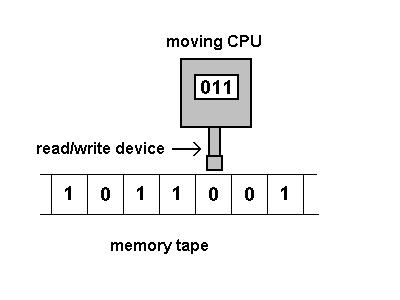
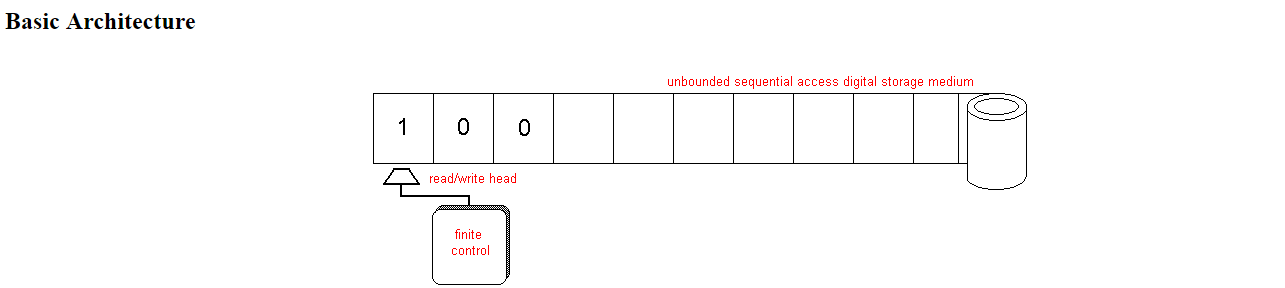
This is an easy representation of how the Turing Machine works.


With the image down below, I want to show you the way that Von Neumann`s machine work. 


But, what are the similarities between both creations?

Both have the same essential building blocks, but organize it in a different way. They use the same algorithm (zeros and ones) in a coded form, and have inputs and outputs


I hope you liked this post and were able to learn some new things! 


Turing-machine-like structures in a V Neumann architecture

Today we saw a video about how a V. Neumann CPU architecture works, and I found it really simple, once I've seen the video twice, with all the images that are provide in there you will catch the idea really fast.
Now I`m gonna talk about structures of a turing machine, that you will be able to find on a CPU-RAM. 


We found many turing machine structures in this kind of architecture (a V. Neumann CPU architecture), for example: the connection between CPU- Ram, this connection is really simple.

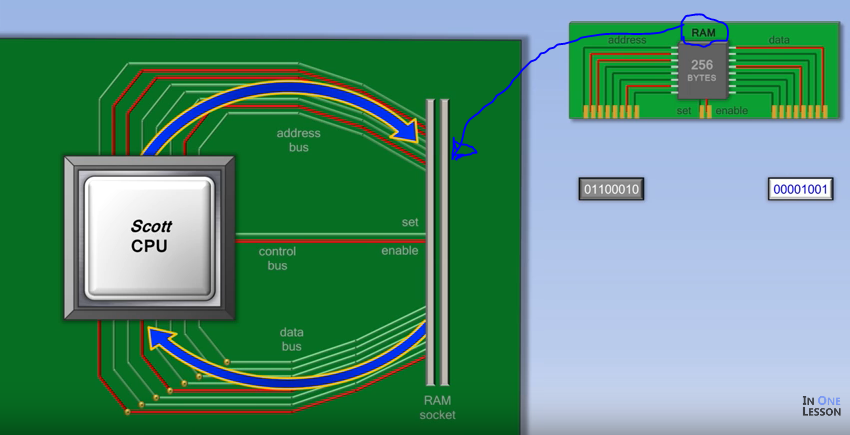
The ram contains all the information that process the CPU. The CPU sends an address to the ram, and via the enable cable, it tells the ram to process the address and the ram gives a date to the CPU, and this process repeats itself really fast and really frequently. We can see that the CPU makes an input and the ram an output, this output is going to be an input for the CPU.

Picture from the vid. "How a CPU Works" from "In One Lesson"


Another example is inside the CPU, precisely the control unit and ALU. Typically, the ALU has direct input and output access to the processor controller, main memory (RAM), and input/output devices. Inputs and outputs flow along an electronic path that is called a bus. The input consists of an machine instruction word that contains an operation code, one or more operands, and sometimes a format code.
The operation code tells the ALU what operation to perform and the operands are used in the operation. (For example, two operands might be added together or compared logically.) The format may be combined with the op code and tells, for example, whether this is a fixed-point or a floating-point instruction.
The output consists of a result that is placed in a storage register and settings that indicate whether the operation was performed successfully. (If not a status will be sorted in the machine status word)


pic. from the website pitt.edu


pic. from the website pitt.edu

I've made a Mindmap to explain the Turing machines and the V Neumann architecture.


Here is the link to the video that explains how a CPU works  Click here.


Turing machine-like structures in a V Neumann architecture

Today we saw a video about how a v. Neumann CPU architecture works, it's pretty easy once you have seen how it works. We found many turing machine structures in this kind of architecture, for example: the connection between CPU- Ram, it’s really simple, so ram contains all the information that process the CPU. The CPU sends an address to the ram, and via the enable cable, it tells the ram to process the address and the ram gives a date to the CPU, and this process repeats itself really fast and really frequently. We can see that the CPU makes an input and the ram an output
Captura.PNG
Another example is inside the CPU, precisely the control unit and ALU. Typically, the ALU has direct input and output access to the processor controller, main memory (random access memory or RAM in a personal computer), and input/output devices. Inputs and outputs flow along an electronic path that is called a bus. The input consists of an instruction word (sometimes called a machine instruction word) that contains an operation code (sometimes called an "op code"), one or more operands, and sometimes a format code. The operation code tells the ALU what operation to perform and the operands are used in the operation. (For example, two operands might be added together or compared logically.) The format may be combined with the op code and tells, for example, whether this is a fixed-point or a floating-point instruction. The output consists of a result that is placed in a storage register and settings that indicate whether the operation was performed successfully. (If it isn't, some sort of status will be stored in a permanent place that is sometimes called the machine status word.)

Can you find a couple of Turing-machine-like structures in a V Neumann architecture?


  Recently, I've seen a video on the funtioning of Turing machines and how a CPU works. I can say that the three videos were very interesting and that is why I search if there were structures of the Turing machines that function as building blocks for V. Neumann's structure. Below I will leave a link to the three videos so you can see them if you are interested. After viewing the two videos, I created a mindmap with a page named mindomo explaining the concepts of the Turing machines and the V. Neumann architecture that I will show you down. Finally I will answer a quick question; Can you find a couple of Turing-machine-like strucures in a V. Neumann architecture?


Make your own mind maps with Mindomo.

Similarities


Resultado de imagen para binary code

  • Both uses codes with 1 and 0, and recive and send information
  • The turing machin creates an output and an input, and the V Neumann makes it with the ALU.


Also the V. Neumann structure uses the Turing machine to solve and asnwers problems